If you’re considering Invisalign, the first question on your mind is probably how long it will take. The honest answer is that treatment time varies from person to person, but most adults and teens finish somewhere between 6 and 18 months. The exact length depends on how much tooth movement your case requires, how consistently you wear your aligners, and the specific corrections being made.
Some patients with minor spacing or mild crowding may wrap up in as little as 6 months. Others dealing with more complex bite issues or significant misalignment may need closer to 18 to 24 months. Knowing where your case is likely to fall can help you plan realistically before you ever sit in the dentist’s chair.
This guide breaks down the Invisalign timeline in plain terms, covering what drives treatment length, how the process works from your first scan to your last tray, and what you can do to stay on track.
Key Takeaways
-
Most Invisalign cases take between 6 and 18 months, with complex bite issues pushing timelines closer to 24 months.
-
Wearing your aligners 20 to 22 hours per day is the single biggest factor you can control to keep treatment on schedule.
-
The type and severity of correction needed, from mild spacing to bite problems, determines how many aligner trays you will need.

Typical Treatment Timeline
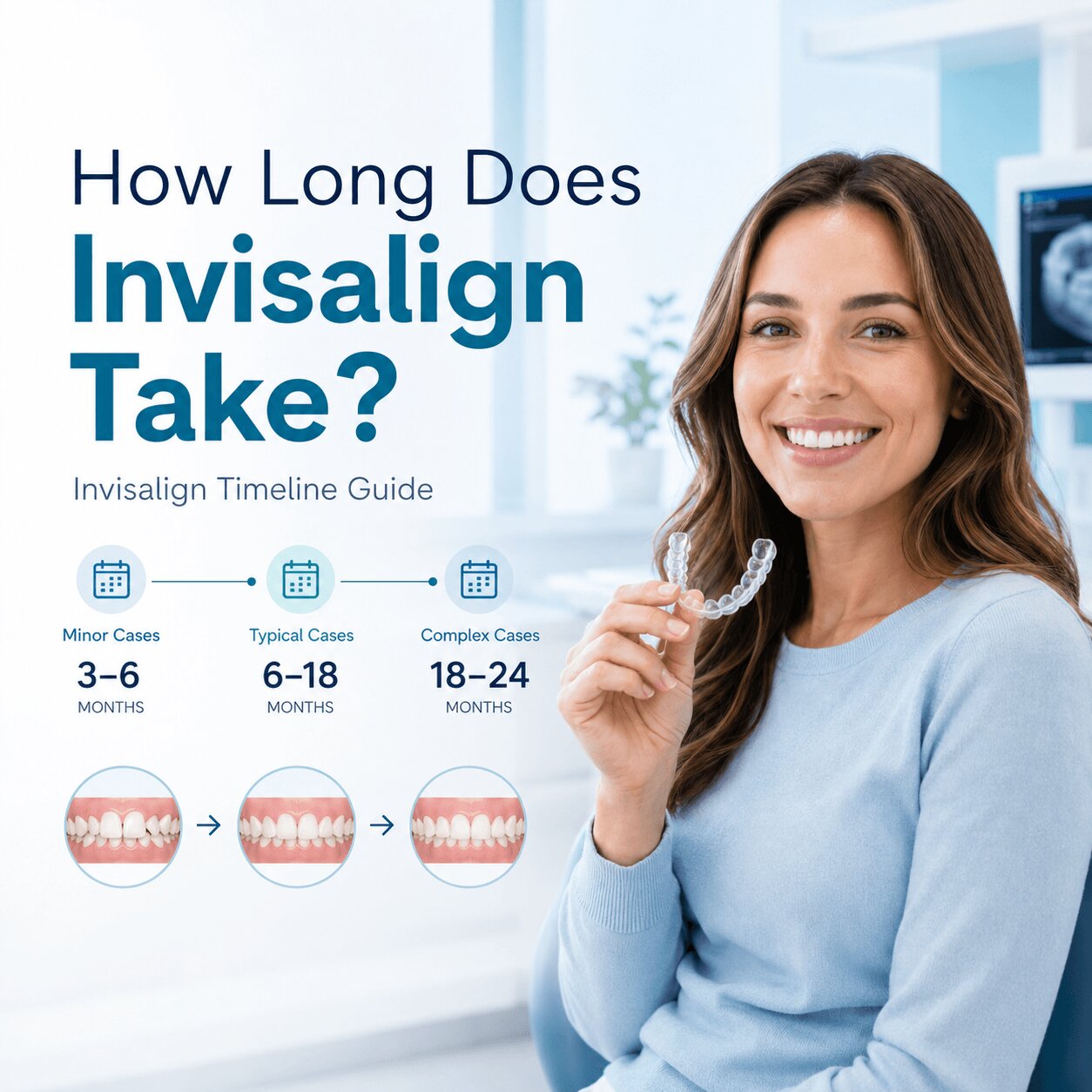
Most patients fall somewhere in the 6 to 18 month range, but minor cases can finish much faster and complex cases may extend beyond that window. Noticing early changes is common within the first few weeks, though the full result takes time to develop.
What Most Patients Can Expect in 6 to 18 Months
For the average adult or teen with moderate alignment needs, the Invisalign timeline lands between 12 and 18 months. This range covers most cases of mild to moderate crowding, small gaps, and minor bite discrepancies.
Each set of aligners is typically worn for one to two weeks before switching to the next. Over the course of treatment, you may go through anywhere from 20 to 50 or more individual trays depending on your case.
When Minor Cases May Finish Faster
If your concerns are limited to mild crowding or very small spacing issues involving just a few teeth, treatment can sometimes conclude in as little as 3 to 6 months. These fast Invisalign cases involve minimal tooth movement and a smaller total number of trays.
Not every patient qualifies for a short timeline. A dentist needs to confirm that your case is genuinely minor before projecting a shorter duration.
When Complex Cases Can Take Longer
Severe misalignment, significant bite correction, or rotation of multiple teeth can push your Invisalign timeline to 18 to 24 months. These cases require more aligners and sometimes additional steps like attachments or refinements.
Bite problems such as overbites and underbites are among the most time-intensive corrections. The more complex the movement, the longer the process takes.
When You May Start Seeing Changes
Many patients notice visible tooth movement within the first 4 to 6 weeks of treatment. This early progress is one of the more motivating parts of wearing clear aligners, since you can see gradual improvement while treatment is still ongoing.
Keep in mind that early movement does not mean early completion. Consistent daily wear and scheduled tray changes are what carry results through to the finish line.
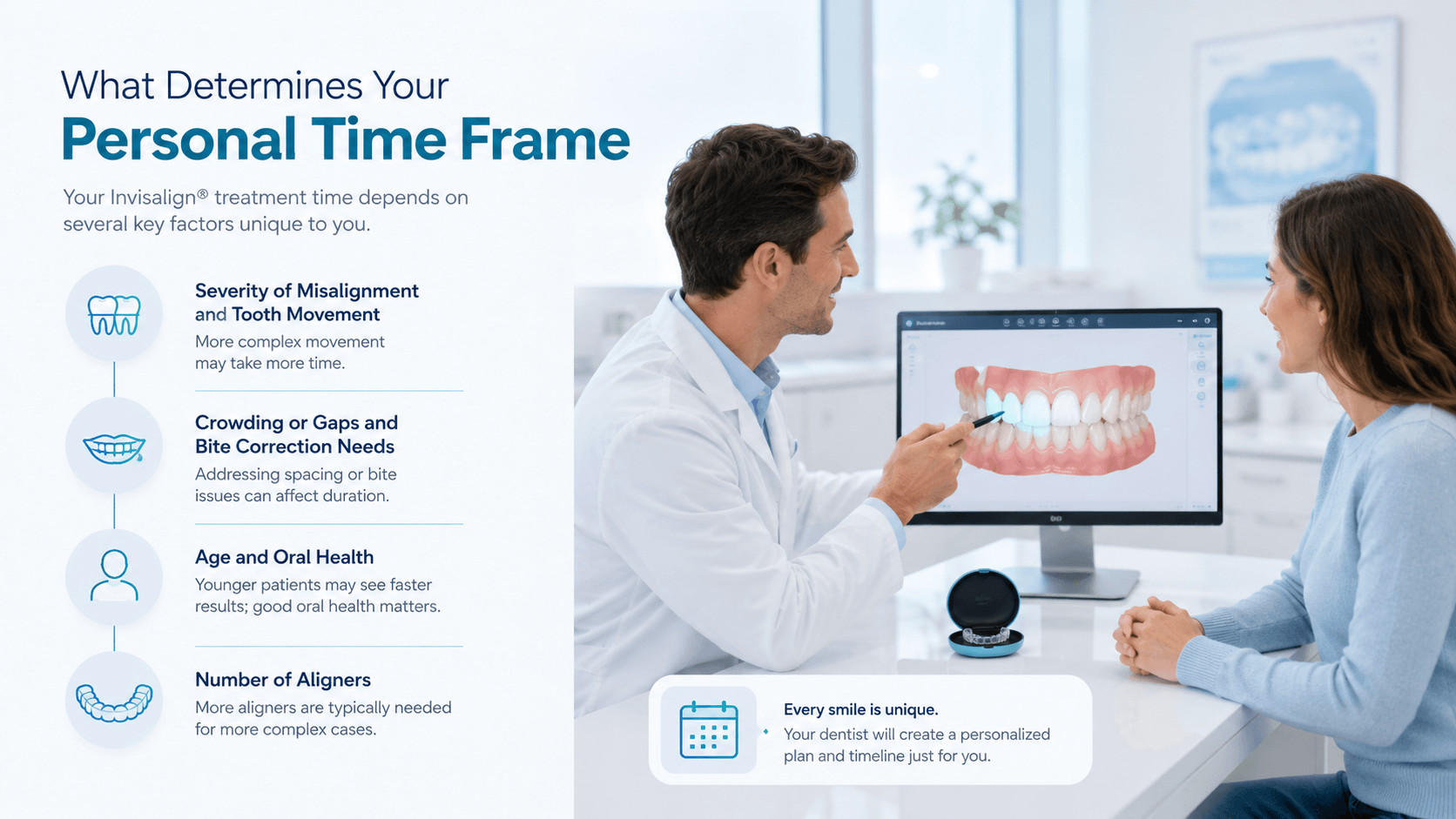
What Determines Your Personal Time Frame
Your Invisalign treatment time is shaped by the biology of your teeth, the complexity of your case, and the number of aligners your plan requires. Understanding these factors helps set realistic expectations before your consultation.
Severity of Misalignment and Tooth Movement
The amount of movement your teeth need to make is the primary driver of treatment length. Minor shifts take fewer aligners and less time. Significant rotation, tipping, or repositioning of multiple teeth takes considerably more.
Severity of misalignment is assessed at your initial consultation using digital scans or impressions. The more movement required, the longer your projected timeline will be.
Crowding, Gaps, and Bite Correction Needs
Crowding, gaps between teeth, and bite issues each carry different levels of complexity. Mild crowding or a single small gap can often be addressed in a shorter treatment window.
Bite problems are typically more involved. Correcting an overbite, underbite, or crossbite requires the aligners to move teeth in very specific ways, often adding months to the process. More complex bite problems may also require attachments bonded to the teeth to help guide movement.
Age, Bone Remodeling, and Oral Health
Bone remodeling is the biological process that allows teeth to shift. In younger patients, this process tends to happen more quickly because the bone is still developing and more responsive. Adult teeth require the same process, but it can move at a slower pace.
Oral health also plays a role. Active gum disease, untreated decay, or bone loss can delay or complicate treatment. These issues are typically addressed before Invisalign begins.
How the Number of Aligners Affects Duration
Your total number of aligners is directly tied to your treatment length. Each tray represents approximately one to two weeks of wear. A plan calling for 24 trays will generally take less time than one with 48 trays.
Your dentist calculates the number of aligners needed based on your digital treatment plan, which maps out every planned tooth movement from start to finish.
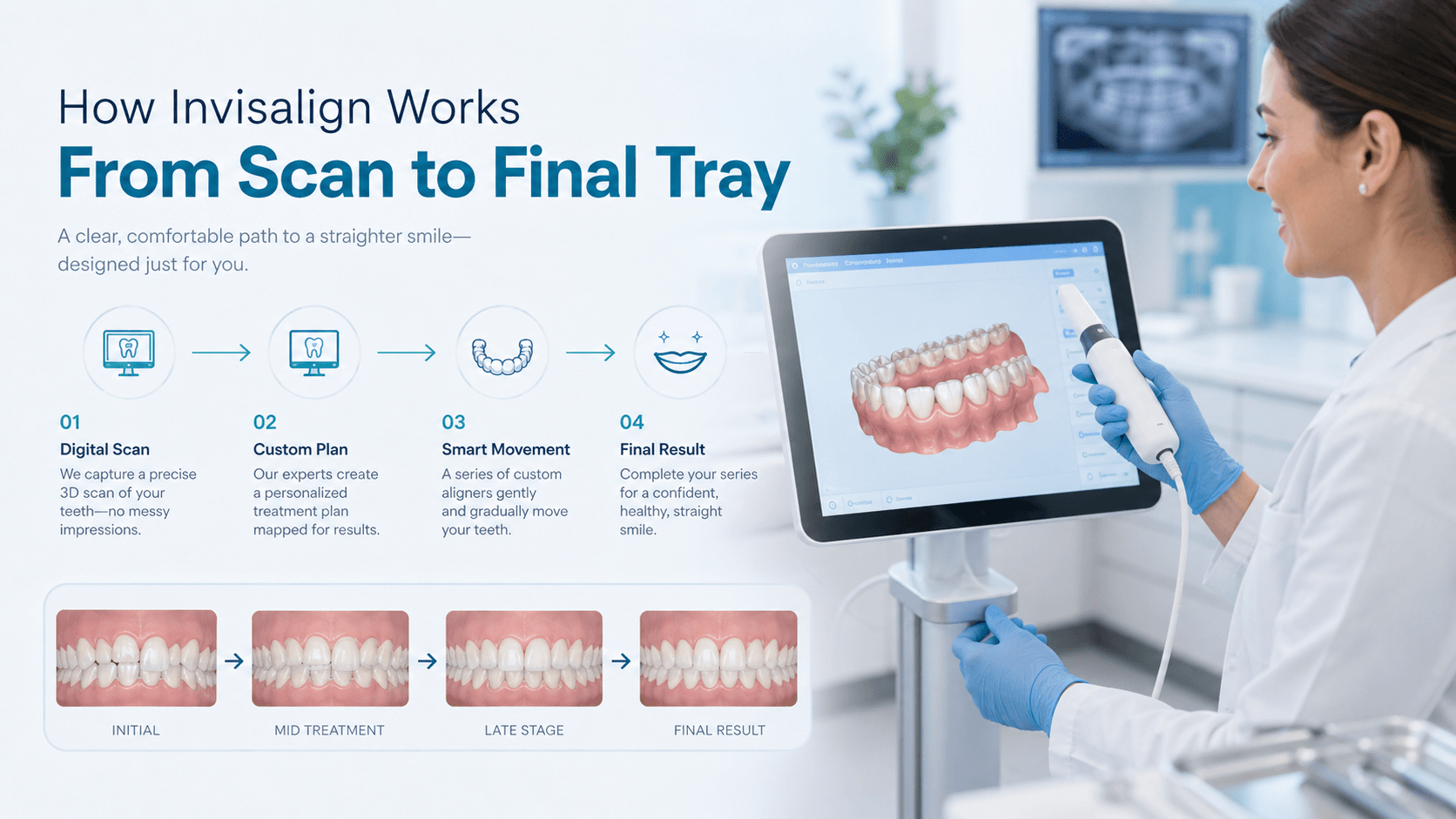
How Invisalign Works From Scan to Final Tray
Invisalign treatment follows a structured sequence: digital planning, custom aligner fabrication, progressive tray changes, and periodic refinements if needed. Each stage plays a direct role in how efficiently your teeth move.
Invisalign Consultation and Digital Planning
Your Invisalign consultation starts with a full assessment of your teeth, bite, and jaw. An Invisalign dentist uses digital scanning technology to create a precise 3D model of your mouth.
That model feeds into specialized software that maps out every planned tooth movement. The result is a step-by-step digital treatment plan showing where your teeth are now and where they need to go.
Custom Treatment Plan and Custom Made Aligners
Once your plan is finalized, your custom-made aligners are fabricated. Each tray in the series is slightly different from the last. The difference is subtle but deliberate, applying light, targeted pressure to guide specific teeth toward their correct positions.
The total set of custom aligners is manufactured before your treatment begins. Your dentist will typically give you several trays at a time to switch through between appointments.
How Aligner Changes Move Teeth Gradually
Switching to a new set of clear aligners every one to two weeks is how Invisalign creates steady progress. Each tray builds on the movement made by the previous one. You may feel mild pressure or tightness with each new tray, which is a normal sign that the aligners are working.
Wearing your aligners for 20 to 22 hours per day during each stage is essential. Falling short of this consistently can slow or stall progress, since the teeth do not receive enough sustained pressure to move as planned.
Why Refinements Sometimes Extend Treatment
Refinements are additional aligner sets ordered partway through or near the end of treatment. They are used when teeth have not moved exactly as predicted, or when fine-tuning is needed to reach the final result.
Refinements are a normal part of Invisalign treatment, not a sign that something went wrong. They do add time, typically a few weeks to a few months, depending on what adjustments are needed.
Estimated Time by Orthodontic Concern
Treatment duration varies meaningfully depending on what is being corrected. A few months may be enough for simple cases, while bite correction or severe misalignment typically requires a much longer commitment.
Mild Crowding and Minor Spacing
Mild crowding involving just a few teeth is one of the fastest cases Invisalign handles. Treatment often falls in the 3 to 6 month range. Minor spacing corrections in this category can follow a similar timeline.
These cases have fewer aligners and simpler movement requirements, which keeps the process relatively brief.
Gaps Between Teeth
Closing gaps between teeth, known clinically as diastema, can take anywhere from a few months to 18 months or more depending on how wide and numerous the spaces are. A single small gap between the upper front teeth often resolves faster than multiple gaps spread across the arch.
In cases where gaps exist because of missing teeth, dental implants may be placed after orthodontic alignment is complete, which adds to the overall treatment timeline.
Overbite, Underbite, and Crossbite Cases
Bite issues are consistently among the longest cases in Invisalign treatment. Overbite and underbite correction can take 18 to 24 months in moderate to severe cases. Crossbite treatment falls in a similar range.
These corrections require precise and complex tooth movement. Attachments are often used to help achieve the angulation and positioning that aligners alone cannot easily create.
Moderate to Severe Alignment Problems
Severe misalignment that affects multiple teeth across both arches generally requires the full scope of Invisalign treatment, with timelines running 18 to 24 months or longer. Some very complex cases may not be fully addressable with clear aligners alone and may need to be combined with other dental work.
A thorough evaluation with an experienced Invisalign dentist will clarify whether clear aligners can handle your case and what a realistic timeline looks like.
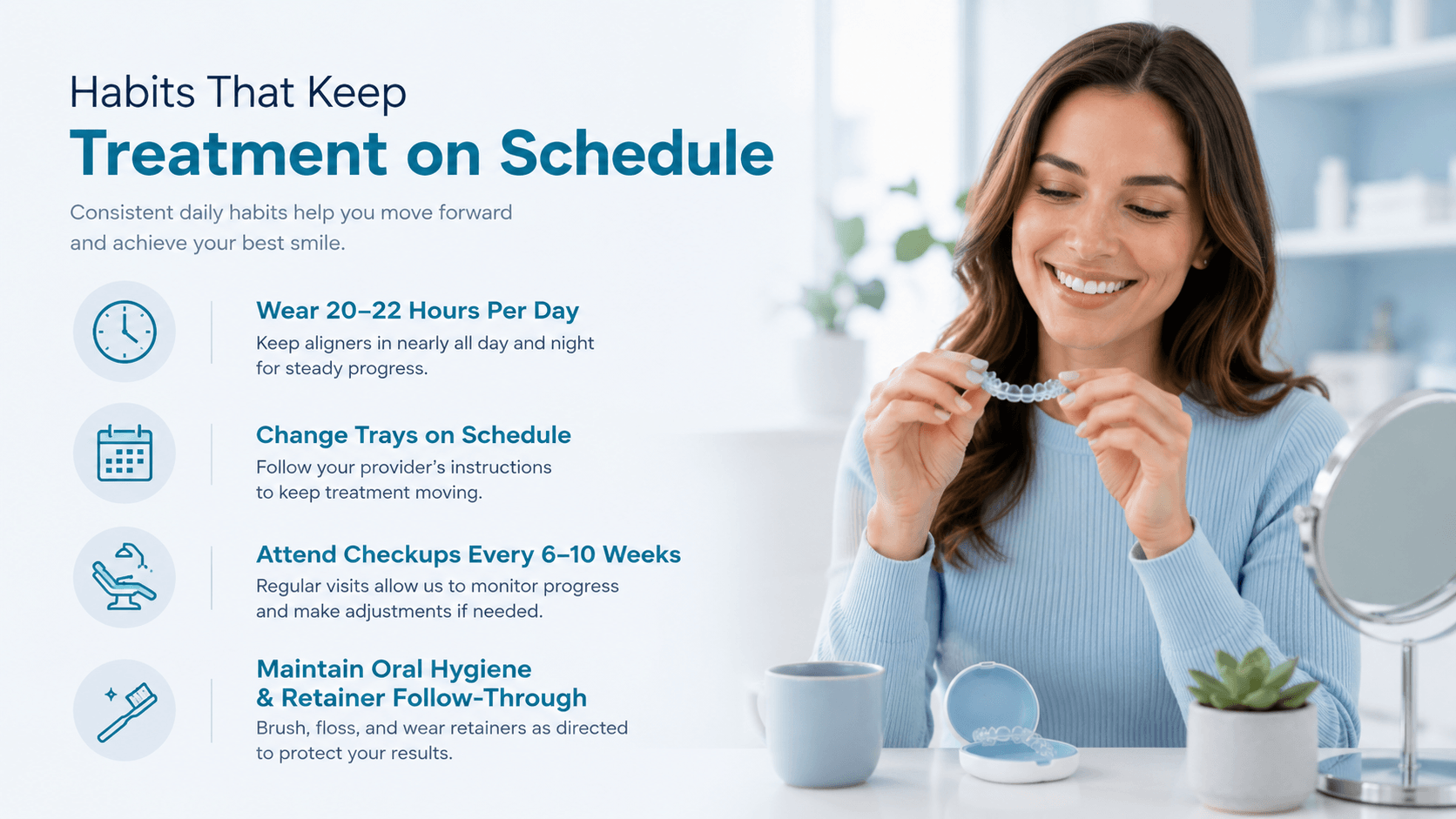
Habits That Keep Treatment on Schedule
Your daily habits during Invisalign treatment have a direct effect on whether your timeline stays on track or stretches longer than projected. Consistency is not optional; it is the core of how aligner treatment works.
Daily Wear Time and Consistency
Aligners need to be worn for 20 to 22 hours per day to move teeth as planned. That leaves a small window of 2 to 4 hours for eating, drinking anything other than water, and cleaning your teeth.
Skipping hours consistently, even by an hour or two each day, can reduce the pressure your aligners apply and slow tooth movement. Over weeks and months, this adds up to measurable delays in your invisalign treatment time.
Changing Trays on Time
Switching to a new tray on the scheduled day is just as important as wearing time. Extending a tray beyond its intended wear period does not accelerate treatment; it simply postpones the movement that the next tray is designed to create.
Follow the schedule your dentist sets. If a new tray feels tighter than expected, that usually means the previous tray still has room to do its job before you switch.
Keeping Checkups and Monitoring Progress
Regular checkups allow your dentist to confirm that teeth are moving correctly and that each tray is fitting as planned. These visits are typically scheduled every 6 to 10 weeks and are an important part of keeping your aligner changes on track.
Missing appointments can delay the detection of fit issues or movement problems, which may require extra steps to correct later in treatment.
Oral Hygiene and Retainer Follow Through
Clean teeth and aligners are part of keeping treatment efficient. Buildup on trays can affect how they fit, and poor oral hygiene can lead to gum inflammation that complicates movement.
Once treatment is complete, wearing your retainer as directed protects the time you invested. Teeth can shift back without retainer use, which may require additional treatment to correct.
Benefits, Limitations, and Choosing the Right Provider
Invisalign is a reliable option for a wide range of alignment concerns, but it works best when the treatment fits the case and the provider has the experience to plan it properly. Knowing both the benefits and the limits helps you make an informed decision.
Benefits of Invisalign for Adults and Teens
Clear aligners offer several practical advantages over traditional braces. They are removable, which makes eating and oral hygiene much easier to manage. The trays are nearly invisible in day-to-day life, which many patients find valuable for professional and social situations.
Treatment is also trackable from the start. Your digital plan lets you see the projected outcome before you even begin wearing your first tray.
When Clear Aligners Are a Good Fit
Clear aligners are well suited for mild to moderate crowding, spacing issues, and many bite corrections. Adults and teens who are disciplined about daily wear tend to see the best results.
Patients who have had past dental work such as crowns or bridges can often still pursue Invisalign, though those restorations may require adjustments to the treatment plan since they respond differently to movement than natural teeth.
When Another Treatment May Be Recommended
Very severe misalignment or certain types of tooth movement may be beyond what clear aligners can accomplish alone. In some cases, traditional braces provide more precise control, particularly for complex rotations or significant vertical movement.
Your dentist will let you know if Invisalign is appropriate for your case or if a different approach would be more effective. An honest assessment upfront prevents wasted time and money.
What to Look for in an Experienced Dentist
An experienced Invisalign dentist will take a thorough 3D scan, explain your projected treatment plan in plain terms, and give you realistic timelines based on your actual case, not a generic estimate. Transparency about cost, duration, and what the process involves is a sign of a trustworthy provider.
Practices like Alexander Visot, DDS in Woodland Hills are known for clear explanations and honest treatment planning, which matters when you are committing to a multi-month orthodontic process. You can reach their office at (818) 225-7768 to ask about a consultation.
Frequently Asked Questions
How many months does it usually take to see noticeable results from clear aligners?
Most patients notice visible tooth movement within the first 4 to 6 weeks of wearing aligners consistently. The changes are gradual, but because you can compare trays side by side, progress tends to feel more visible than with traditional braces.
What factors can make orthodontic aligner treatment take longer or shorter?
The main factors are the severity of the misalignment, the type of correction needed (crowding, gaps, or bite issues), your age, and how consistently you wear your aligners each day. Missing wear hours or appointments adds time; disciplined habits keep treatment on schedule.
How long does aligner treatment typically take for fixing an overbite?
Overbite correction with Invisalign typically takes between 18 and 24 months for moderate to severe cases. Mild overbites may resolve somewhat faster, but bite issues generally fall on the longer end of the treatment timeline.
How long does it take to close gaps between teeth with aligners?
A single small gap may close within a few months. Multiple gaps or wider spacing can take 12 to 18 months or longer. The size, number, and location of the gaps all influence the total treatment time.
How often do aligner trays need to be changed during treatment?
Most patients switch to a new tray every 7 to 14 days, depending on the schedule set by their dentist. Some providers use a 7-day change schedule for faster-moving cases, while others keep the standard 10 to 14 days per tray.
What happens if you don’t wear your aligners for the recommended hours each day?
Consistently skipping wear time means your teeth are not receiving the sustained pressure needed to move on schedule. The current tray may stop fitting correctly, the next tray may not seat properly, and your overall treatment could take weeks or months longer than originally planned.